

Best Fish Finder for Kokanee
Kokanee salmon – the landlocked cousins of sockeye salmon – are a favorite target for many freshwater anglers in the US and Canada. They’re tasty, they’re a fun fight on the hook, and there’s just something magical about them. These fish often school in deep lakes, making a quality fish finder almost a necessity if you want consistent success. The right fish finder helps you locate the depth and location of kokanee schools, track your lure or downrigger, and distinguish kokanee from other species. But with so many fish finders on the market, which models do kokanee anglers swear by?
In this comprehensive guide, we’ll break down the best fish finders for kokanee salmon, based on the several that we have tried, forum discussions, and other expert advice, and tailored for both U.S. and Canadian waters. We’ve included everything from high-end units loaded with features to budget-friendly options (including the popular Garmin Striker 4) that won’t break the bank. Let’s dive in!
Things to Think About Before Buying a Fish Finder
Before the product reviews, keep in mind what makes a fish finder great for kokanee. Power and Sonar Coverage are key – kokanee often suspend in 20–100 feet of water, so you need a sonar that can shoot a wide cone angle to cover more water and spot those schools. Many entry-level finders have narrow 18° cones (only a ~12 ft circle at 40 ft depth), whereas higher-end units offer wider beams – for example, a Furuno unit with a 48° cone covers a 34 ft circle at 40 ft. In general, the more area your sonar covers, the better your chances of marking kokanee that might be just a few feet below the surface or off to the sides of the boat. Additionally, high resolution (pixels) and CHIRP sonar help differentiate kokanee (which have distinctive air bladders) from other fish like trout. Many seasoned kokanee anglers also advise using side imaging if available, since kokanee can be boat-shy and often move away from the boat’s path – side-scan can reveal schools off to the sides that you’d otherwise miss. With those tips in mind, let’s look at the top fish finders and why they’re recommended for kokanee fishing.

Quick Comparison Table
| Model | Type | Best For | Price Tier |
|---|---|---|---|
| Garmin ECHOMAP UHD 73sv | CHIRP + ClearVü + SideVü | Best Overall | $$$ |
| Humminbird Helix 7 CHIRP G4N | CHIRP + MEGA Imaging | Runner-Up | $$$ |
| Lowrance Elite FS 7 | CHIRP + SideScan + DownScan | Mid-Range Versatility | $$ |
| Lowrance Hook Reveal 7 TripleShot | CHIRP + DownScan + SideScan | Best Value | $ |
| Garmin Striker 4 | CHIRP Only | Budget/Portable | $ |
The fish finders below include links to Amazon. We earn from qualified purchases on Amazon at no additional expense to you, which helps us continue to do kokanee research, and puts more gas in our boat. Real talk though- we like buying our electronics on Amazon. If there are any issues, or if I’m not completely satisfied, Amazon’s awesome return policy makes me feel good about trying something new, like a fish finder, with a lot less risk.
Garmin ECHOMAP UHD 73sv – Best Overall
Not only is this probably the best option for kokanee boats, but its also one of the best all around fish finders on the market. This fish finder is highly recommended by kokanee anglers, this Garmin unit includes CHIRP 2D sonar, ClearVü, and SideVü. The side imaging is key for spotting kokanee off to the sides—important since kokanee often avoid boats. Bright screen, detailed GPS maps (U.S. preloaded), and optional Panoptix LiveScope compatibility make it top-tier. It’s available with a 6″, 7″, or 9″ screen. Bigger is definitely better, but I’ve personally only used the 7″ model, and it was plenty big. If you’ve got space, size up for sure though. I’ve never heard anyone complain about their screen being too big.
Another awesome feature of the ECHOMAP is that its compatible with Panoptix LiveScope – Garmin’s live sonar system that shows fish in real time. Panoptix is pricey, but it’s worth noting: one forum expert said “nothing else comes close” to LiveScope for finding kokanee – he could spot individual fish and schools 200 feet around the boat in real time. The ECHOMAP allows you to upgrade tech without having to buy a whole new unit. This is the best option for today, and is also going to be great 5 years from now.
Why We Like It for Kokanee:
The ECHOMAP’s combination of CHIRP + ClearVü + SideVü gives you a comprehensive view of what’s under and around your boat. You can detect kokanee at depth and also see bait balls or schooling fish off to the sides (great for spooked kokanee). The high-resolution screen makes it easier to distinguish kokanee “blips” from other fish, and the unit has plenty of power to mark targets even down past 100 feet. Garmin’s QuickDraw mapping can even create depth maps of your lake as you troll, useful for finding underwater humps or drop-offs where kokanee might congregate. Simply put, this unit covers all the bases – mapping, sonar, and future expandability – which is why it’s our top pick.
Pros: Side imaging, upgrade-ready, quality sonar
Cons: Higher price, charts for Canada may cost extra

An additional view of kokanee salmon on the Garmin ECHOMAP Fish Finder

There are a number of different view options for this Garmin, but this is the view I usually run when chasing kokanee.
Humminbird Helix 7 CHIRP G4N – Runner-Up
I’ll be honest, I’m a little biased towards Garmin. They’re not a sponsor, but I’ve used their gear for running, hunting, hiking, and of course for fishing. They’re a brand I trust. The other really popular brand I see people using is the Humminbird brand. The one that gets the runner-up spot on our list of best fish finders for kokanee is the Helix 7. The Helix 7’s Dual Spectrum CHIRP and optional MEGA Side Imaging provide excellent clarity. It’s favored for its detailed sonar arches and ability to track downrigger weights. The arches on the screen really are extremely clean and clear. That part did impress me. Mapping is another strong area with LakeMaster or Navionics support.
Why We Like It for Kokanee:
The Helix 7 provides sharp target separation and enough power/pixels to show kokanee even when they’re mixed with other fish or near bottom. Its CHIRP sonar will make the classic kokanee “arches” pop on screen, and if you have Down Imaging active, you can sometimes spot the thermocline or plankton layers that kokanee will often feed on. The ability to use a wide beam is useful for covering more water – for example, in wide mode you might get a ~42° cone that helps detect fish outside the narrow column under the boat. Also, Humminbird’s side imaging (Mega SI), if you opt for it, is one of the best in the industry for detail and range. It can help you find schools that your down-looking sonar might miss. With the Helix’s excellent mapping and waypoint management, you can mark every kokanee bite or school you find and build your own kokanee hotspot map of the lake. It’s a reliable, proven unit that many kokanee anglers trust for consistent results.
Pros: Great sonar target separation, solid mapping options
Cons: No touchscreen, side imaging model costs more

Lowrance Elite FS 7 – Best Mid-Range
Lowrance is the last of the big 3 fish finder brands. They also put out a quality product. The Elite FS 7 made our list of some of the best kokanee fish finders because of its solid imaging and sonar. That’s not all it has though. This model touts a touchscreen plus keypad controls. On the imaging side, it uses CHIRP sonar, and optional 3-in-1 transducer (SideScan + DownScan + 2D). It also supports FishReveal to highlight fish over DownScan returns. The mapping with C-MAP Contour+ is very user-friendly.
We call this our best Mid-Range option, because it’s 7″ screen option is a couple hundred bucks less than the Garmin or Humminbird models. That said, it also has a 9″, 10″, and even a 12″ model, which moves it well out of the mid-range tier. In fact, its one of the biggest screen options available for a fish finder without dropping thousands.
Pros: Strong sonar and imaging, GPS maps, intuitive UI
Cons: More complex than basic units, charts vary by region

Lowrance Hook Reveal 7 TripleShot – Best Value
The Lowrance Hook is an excellent budget unit with CHIRP, DownScan, and SideScan. FishReveal highlights fish on DownScan. It’s easy to use, with autotuning sonar and optional map card support. This fish finder is great for beginners or smaller boats. It’s available in 4 different sizes, from 4″ all the way up to a 9″ model. Again, bigger is better, but its impressive to get the features at a cheaper price if you go for the 4″ model. You really have the ability to choose your price point with the screen size with this one.
Pros: Affordable, triple sonar modes, simple interface
Cons: Lacks networking, mapping upgrades cost extra

Garmin Striker 4 – Best Budget Option
For under $200, this compact unit offers CHIRP sonar and GPS waypoint marking. This unit is great for portable setups or kayak users. I personally have the ice fishing bundle, and I did an experiment, taking the Garmin Striker 4 ice fishing bundle out trolling. I was pleasantly surprised at how well it worked. You can get away with using the same transducer that you would use for ice fishing. If you’re looking to really save money, you can use this as an all season fish finder option. It doesn’t have any built-in maps, but has reliable sonar for tracking kokanee at 50–100 ft depths, though I’ve only used it in 90 ft of water, so though I don’t have any reason to doubt it, I can’t personally confirm that particular claim.
With the low price point, you’re sacrificing screen size and additional tech features. It only has the CHIRP sonar, not the other two types. You can definitely get by with just the CHIRP, but you are sacrificing the ability to see more and see further. You also don’t have the same mapping that the others have. That said, it gets you marking fish without much pain to your wallet.
Pros: Inexpensive, portable, CHIRP sonar clarity
Cons: Small screen, no maps, no imaging features
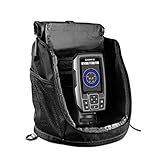
Additional Views of the Garmin Striker 4 Fish Finder


A view of some kokanee I marked on the Garmin Striker 4.
Pro-Level Bonus: Garmin Panoptix LiveScope
If money is no object, LiveScope gives you real-time sonar showing fish and lures live. Some anglers swear it’s game-changing, but the total setup can run $2,000+. Most don’t need it—but it’s unmatched for scouting schools and adjusting gear instantly. This really is the best you can get on the market, and its compatible with some of the other Garmin fish finders.
Buying Tips for Kokanee Fish Finders
- Sonar Power & Cone Angle: Wide sonar cone (e.g., 40°+) helps cover more water. CHIRP improves target separation.
- Screen Size: 5–7″ minimum; larger helps for split-screen and detail. You can get away with smaller screens, but you’ll be happier with bigger.
- GPS & Mapping: Handy for marking waypoints and tracking troll paths. Choose models with built-in or upgradeable maps.
- Side Imaging: Helpful for spotting kokanee off to the sides—ideal on larger lakes.
- Portability: Small, battery-friendly units like Striker 4 work great for kayaks or rentals.
Final Thoughts
If you want the best fish finder that checks all the boxes for kokanee fishing, go with the Garmin ECHOMAP UHD. If you’re watching your budget, the Hook Reveal 7 or Striker 4 are excellent options that still catch kokanee. Whatever your setup, a quality sonar unit is the fastest way to put more of that beautiful tasty silver in your cooler.
Tips for Finding Kokanee Salmon on any Fish Finder:
Schools of kokanee salmon can usually be found in the main body of the lake over the deepest spots. Sometimes, deep underwater canyons provide the preferred habitat causing kokanee to congregate in those areas. When trying to identify a school of salmon on your fish finder, look for multiple fish schooled up at approximately the same depth.
Getting a fish Finder can also help you avoid losing lures to the bottom. Having the lake depth on the monitor is a game changer, and you’ll be able to avoid snagging lures on the bottom. Most people trolling don’t lose many lures if you can see where your lure is and where obstacles on the bottom are. If you need to justify it to your spouse, it’s a great excuse to throw out there.
-

Kokanee Salmon Sushi
Want to enjoy sushi with your fresh-caught kokanee salmon—without the risks of freshwater raw fish? This recipe uses fried kokanee in a sushi roll inspired by shrimp tempura, giving you big flavor with zero danger. Let me show you how to make it easy, safe, and delicious. I have been working on a kokanee salmon…
-

The State of Kokanee at Rockport Reservoir: Fishing Report and Biologists Report | Kokanee Tour of Utah 2025
Rockport Reservoir is a beautiful place to fish. Nestled in northern Utah and surrounded by hills and quiet water, it’s a spot that often gets overlooked. But it was on my list for my kokanee tour of Utah, and I found myself wondering: What’s going on with the kokanee salmon here? I was out on…
-

Deep Fried Kokanee Salmon Recipe
There’s something magical about fish that crackles when you bite into it. While smoked or baked kokanee has its place, sometimes you just want something crispy, salty, and satisfying—especially after a long day on the lake. Deep fried kokanee salmon delivers just that. It’s fast, flavorful, and hard not to love. Whether you’re feeding a…
About Kokanee Salmon
Kokanee salmon are landlocked sockeye salmon, which means they don’t return to the ocean and live their entire lives in lakes or reservoirs before spawning in rivers, streams, or gravel close to lakeshores. These salmon are delicious and are really strong fighters, making them a prime target for anglers, and the popularity of this fish is growing. Kokanee are a schooling fish that feed on zooplankton in the water. They tend to find where these plankton are at and then they congregate and feed all in that one area. These plankton, and the kokanee that feed on them, like to hang in water that is around 50-55 degrees, so these salmon are usually only able to survive in deep alpine lakes and reservoirs, and can be found from depths of 10 feet, all the way down to over 100 feet deep.
About the Author: Lance
Hi, I’m Lance and I’m a kokanee addict. I’ve been fishing for kokanee for most of my life. I love the challenge of finding these tasty and fun fighting fish. I took my kokanee fishing to the next level, and started writing and getting more scientific about it in 2019. Since that time, I’ve tried just about every kokanee lure, dodger, flasher, scent, and bait on the market. It’s my goal to help people get onto kokanee easier, to have states and provinces introduce more kokanee to lakes and reservoirs, and overall increase attention to kokanee management and conservation. When it comes to fish finders, I own a couple of the ones above, but I’ve fished with friends and colleagues that run all these other models.


